“If marketing has one goal, it’s to reach consumers at the moments that most influence their decisions.” Yep, pretty simple. Now Granted, this is much easier said than done.
For as long as I can remember, marketers have approached this process with the help of a funnel, the purchase (or marketing) funnel to be precise. The funnel is a model which describes the theoretical customer journey from the moment someone first becomes aware of your brand (ideally) through to purchase. Also inherent in this model was the assumption that consumers start with a number of potential brands at the beginning of the process and narrow those choices to one as they move through the funnel from awareness to purchase (and hopefully a lifetime of repeat purchase.)
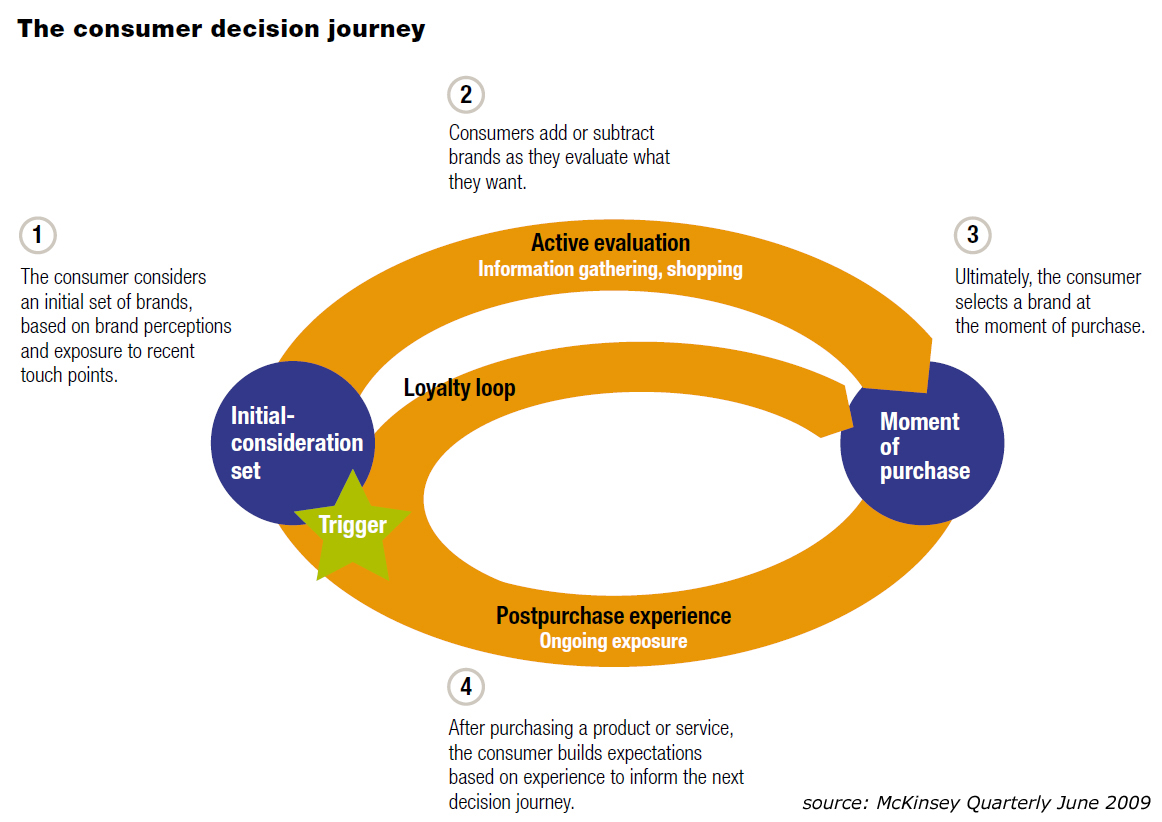 That was until McKinsey did a little research (in 2009) into the topic and found that the “funnel concept fails to capture all the touch points and key buying factors resulting from the explosion of product choices and digital channels, coupled with the emergence of an increasingly discerning, well-informed consumer.” They describe the funnel as “a more circular journey, with four primary phases representing potential battlegrounds where marketers can win or lose: initial consideration; active evaluation; closure; and postpurchase.”
And interestingly:
“Contrary to the funnel metaphor, the number of brands under consideration during the active evaluation phase may now actually expand rather than narrow as consumers seek information and shop a category. The number of brands added in later stages differs by industry: our research showed that people actively evaluating personal computers added an average of 1 brand to their initial consideration set of 1.7, while automobile shoppers added 2.2 to their initial set of 3.8”
So the notion of having to be on someone’s shopping list is not as critical as once imagined (although it should be duly noted that “brands in the initial-consideration set can be up to three times more likely to be purchased eventually than brands that aren’t on it.”
The other key finding, which is quickly becoming a matter of record, is their conclusion that “marketers must move aggressively beyond push-style communication and learn to influence consumer-driven touch points.” The research found that “two-thirds of the touch points during the active evaluation phase involve consumer-driven marketing initiatives, such as internet reviews and word-of-mouth recommendations from friends and family, as well as in-store interactions and recollections of past experiences.”
One other point that is worth emphasizing is McKinsey’s distinction between active and passive loyalists. Active loyalists are those that not only stick with a brand but recommend it to others; passive loyalists stay with a brand without being committed to it. Obviously having more active than passive loyalists engaging with your brand is a good thing.
I would strongly encourage anyone in the marketing business to read McKinsey’s write-up (McKinsey Quarterly 2009 Number 3), posted here for your convenience. It is smart, well-grounded and a model that can help us all do our jobs better.
Call me an active loyalist.
 Northampton Consulting