Oh What a Tangled Web.

So I went a bit further down the rabbit hole this weekend and learned some more about the players involved in the $220 million contract with DHS.

The Past Few Days

But first a quick update on the latest news since publishing the first article last week.

  • During the hearings last week, Senator Kennedy asked Secretary Noem if President Trump had said okay to spending $220 million on the campaign. After evading the question, she ultimately said yes, that President Trump had approved her plan.
  • When Trump was asked if Noem had gotten approval from him directly, he said no. Hmmm, one of them’s not telling the truth. However, the campaign was apparently the last straw and ended in Noem’s reassignment to special envoy for The Shield of the Americas.
  • Bottom line, whether President Trump approved the campaign or not, it doesn’t really matter (at least to me). The controversy in my mind lies squarely in the procurement process.

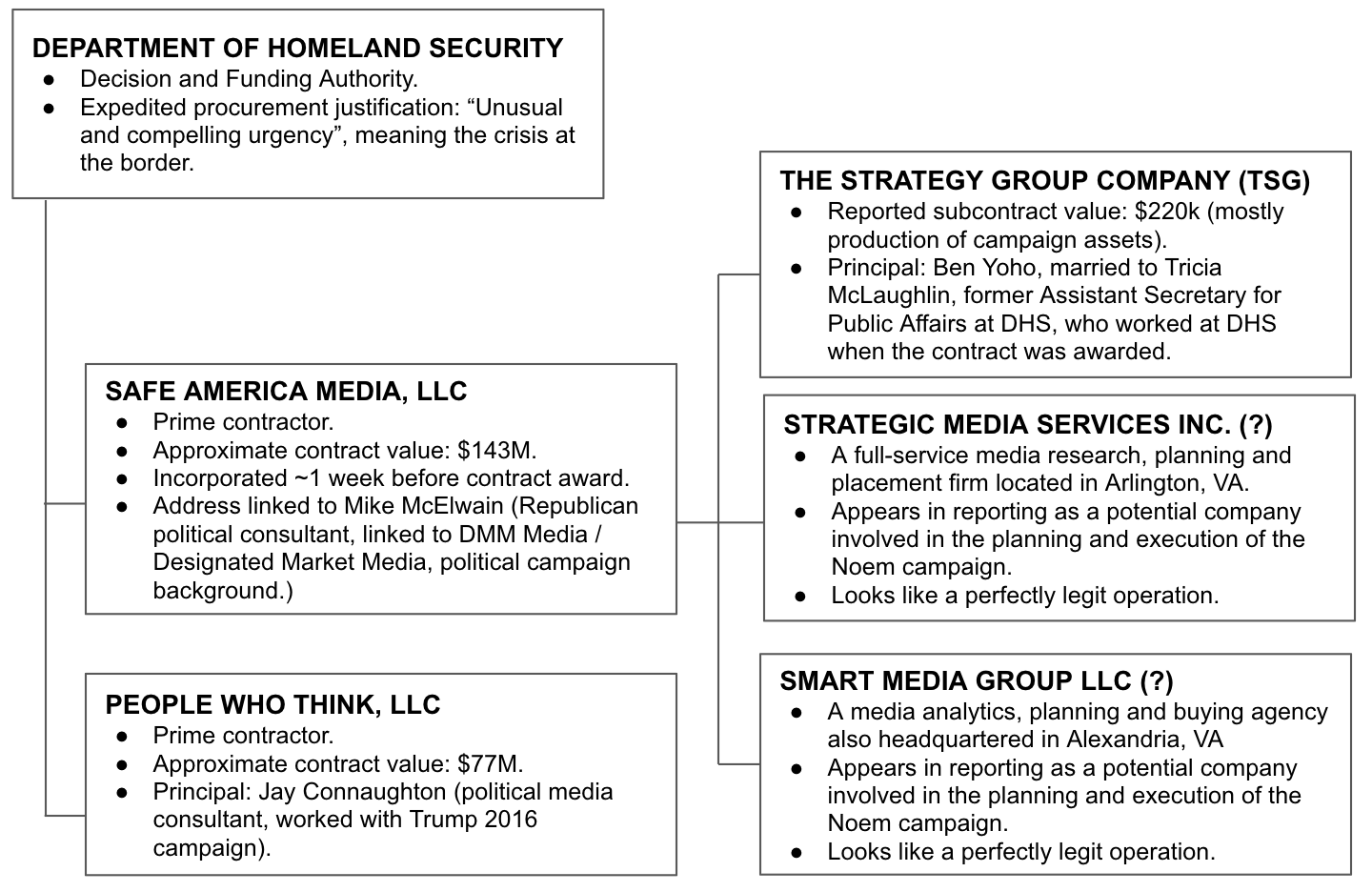
As discussed last week (link), DHS invoked the federal procurement clause for “unusual and compelling urgency.” That designation allows agencies to bypass the normal competitive bidding process. DHS selected Safe America Media, LLC as the prime contractor, a company that was only formed 8 days prior to the awarding of the contract. Note, I included People Who Think as a prime contractor. 

The Players

Based on information out on the world wide web, I’ve tried to piece together the players that touched the infamous $220 million ad campaign. I may have some of this wrong and if I do, please DM me.

To be clear, I don’t think anyone did anything illegal – although the ad campaign probably broke some rules of common decency. It’s the process that’s highly suspect. This is NOT how Federal contracts are supposed to work, at least in my experience.

Lastly, I have deliberately avoided any reference to Corey Lewandowski whose fingerprints are all over the place 😉

(?) Referenced by Bloomberg. I have seen nothing else written about their involvement.

I’d love to hear your thoughts, especially from those that don’t see an issue with the contracting process as outlined in this article.

A $220 Million Ad Campaign. A Company Created Just Eight Days Earlier. And a whole lot of cronyism.

Forget about your politics for a second. This should bother you no matter which side of the aisle you sit on. If the details below are accurate, this looks a lot like taxpayer abuse.

Read on.

Situation Recap

The Department of Homeland Security (DHS) launched a $220 million advertising campaign in 2025, funded by U.S. taxpayers, intended to raise awareness of the crisis at the southern border.

You can debate the policy objective all day long. That’s not the issue here.

The issue is how the contract was awarded and who received it.

Contract Awarded Through an Expedited Process

According to reporting from ALXNow, DHS invoked the federal procurement clause for “unusual and compelling urgency.” That designation allows agencies to bypass the normal competitive bidding process. The justification: the national emergency at the southern border and the need to counter misinformation.

Anyone who has spent time working with federal, state, or local government procurement knows how unusual that is. Competitive bidding isn’t just a best practice in government contracting. It’s practically sacred. “Expedited” and “government contracting” rarely appear in the same sentence.

In congressional testimony on Tuesday, Senator John Kennedy questioned the fairness of the bidding process. According to reporting from National Review, Kennedy pointed out that part of the contract went to a political firm connected to Republican consultant Ben Yoho, Chief Executive Officer at The Strategy Group Company, the husband of former DHS spokeswoman Tricia McLaughlin. So a questionable bidding process AND political ties. Hmmm.

Not surprisingly, Secretary Kristi Noem testified that she was not involved in approving the contract and maintained that the subcontract itself was awarded through a competitive process.

A Newly Created Company Wins the Contract

The primary contractor, Safe America Media LLC, raises even more questions.

The company was incorporated just eight days before receiving the contract and lists an Alexandria, Virginia mailing address. Safe America Media LLC has also been linked to Republican consultant Mike McElwain. “The property is owned by Mike McElwain, a Republican consultant and partner at DMM Media, which is registered in Virginia as Designated Market Media, Inc., according to State Corporation Commission records.”

Further, according to ALXNow, the company did not appear in SAM.gov — the federal government’s contractor registration system — at the time the contract was awarded. That detail surfaced in a March 21, 2025 letter from House Democratic lawmakers to Secretary Noem questioning the legitimacy of the procurement process.

For a contract worth $220 million, that timeline alone should raise some eyebrows.

The End Result: The Ads Themselves

During Senate testimony, Senator Kennedy questioned DHS’s decision to spend $220 million on an immigration enforcement campaign that prominently featured Secretary Noem herself. Noem defended the ads, arguing they were effective at communicating the administration’s deportation efforts and helping reduce illegal immigration. Kennedy responded with a line that summed up the skepticism surrounding the campaign: “It was effective in increasing your name recognition.”

Bottom Line

Strip away the politics and this situation still raises serious questions:

• A $220 million taxpayer-funded advertising campaign with a questionable goal

• Awarded under emergency procurement rules

• To a company formed only eight days before the contract

• That apparently was not registered in the federal contractor system at the time

Maybe there are clean explanations for all of this.

But from the outside, the whole thing smells a bit funny to me. Not to mention the fact that a company formed in 8 days was able to successfully steward a $220 million dollar campaign. Media buying isn’t rocket science but you do have to have some idea of what you’re doing.

As always, I’d love to hear your thoughts. Not on the politics but on the process. Was anyone involved from the supply side that could shed any light on how this went down? Particularly interested in who placed the ads. 

Sources:

  • National Review — “Senate Judiciary Committee Savages Noem over Agency Spending, Personal Ties to DHS Contract Recipient” (March 3, 2026)
  • ALXNow — “Firm using Alexandria address wins $220M federal contract for Trump immigration ads” (October 22, 2025)
Hate Speech

By Tom Hickey, CEO Northampton Consulting

[Author’s note: The on-going saga with Twitter is changing in real-time so my point-of-view may be rendered pointless if Elon and Co. keep changing their policies. In fact, after writing the draft of this piece, Elon suspended a number of journalists under the auspices that they doxxed Elon. He has now reinstated those journalists. By the time I hit publish, who knows where we’ll be. Hell, based on Elon’s tweet over the weekend, he may not be running the company for much longer.]

In full transparency, I do not have the answer to reducing the amount of hate speech on social media to an acceptable level. In fact, it’s pretty safe to assume that there isn’t just one answer.

One of the suggestions, as Michael Benedek, CEO of Datonics proposes in his piece: “Hate Speech On Social Platforms Is Real. Brands Have To Take Action,” is for advertisers to “flex their ad dollar muscles.” We saw this clearly when brands divested from Twitter after Elon Musk took over the reigns of the company.

“In the weeks following the acquisition, more than a third of Twitter’s top 100 marketers stopped advertising on the social media network.”

Michael Benedek, Hate Speech On Social Platforms Is Real. Brands Have To Take Action

While this might be one tactic we can leverage, I’d argue that unless it’s done in a cohesive, collective and uniform fashion, it won’t do much, if anything.

Stepping back a little, my first issue is the research that is cited to prove that hate speech on social media, Twitter in particular, is increasing. “A new report finds that hate speech on Twitter “is soaring” following Elon Musk’s acquisition.” The source for the new report: the Center for Countering Digital Hate. While I am sure that this organization is doing great work, and has the public’s best interests in mind, they also have a clear agenda.

To be fair, so does Elon Musk. “But Mr. Musk has denied claims that hate speech has increased on Twitter under his watch. Last month, he tweeted a downward-trending graph that he said showed that “hate speech impressions” had dropped by a third since he took over. He did not provide underlying numbers or details of how he was measuring hate speech.” Source: The New York Times, “Hate Speech’s Rise on Twitter Is Unprecedented, Researchers Find“.

So where does that leave us? Well, it’s pretty clear: hate speech is increasing and decreasing at the same time.

Before we advance any solutions to the problem, we have to be able to quantify how bad the situation really is. What we really need is a true, third-party solution that provides a supportable, non-biased and comprehensive view of the state of online hate speech. Easier said than done but if we want to find a solution to curbing hate speech, we have to know where we are starting. We can then establish benchmarks for every social media company to meet or exceed OR face significant consequences. TBD on what “significant” means but based on where we are today, nothing so far seems to have worked.

Back to the advertisers that pulled their money from Twitter. Twitter’s share of ad dollars is minor when compared to Google & Meta. If the ad industry is going to truly flex its muscles, don’t we need to do it across all social media, not just Twitter? Make a statement, not a gesture.

And then there’s the impact the ad pullback on Twitter will ultimately have on hate speech. I doubt the folks that are responsible for spreading hate online give a flying sh*t that the ad industry pulled their ad dollars from Twitter. If the goal is to put Twitter out of business, that’s another story altogether. I don’t believe that’s a reasonable solution.

Finally, as we all know, Twitter relies on advertising dollars to keep the company afloat. When the industry limits a critical source of revenue for Twitter, doesn’t it become more difficult to implement/fund a robust content moderation framework, not less?

While there may be a smart, effective way to approach this issue, the only thing the social media platforms are guilty of is amplifying hate speech. I’m less confident that we’ll be able to stem hate speech altogether. Haters will hate and they will find alternative ways to spread their repugnant messages.

As always, I’d love to hear your thoughts.

ICYMI: ChatGPT

By Tom Hickey, CEO Northampton Consulting

Credit: The Indian Express, “OpenAI’s ChatGPT crosses 1 million users in less than a week since launch“, (Image: Screenshot of OpenAI ChatGPT)

Over the past week or so, there has been a groundswell of interest in ChatGPT. If you’re not familiar with ChatGPT, there’s plenty of great info out there on the information superhighway. I’m definitely not an expert on ChatGPT or AI in general so it would be a fools errand for me to try and replicate what a lot of very smart folks are already doing. So I won’t.

What has been fascinating to watch over the weekend is how those refinements have led to an explosion of interest in OpenAI’s capabilities and a burgeoning awareness of AI’s impending impact on society, despite the fact that the underlying model is the two-year old GPT-3.

AI Homework, Ben Thompson

That said, I came across a piece by Ben Thompson entitled AI Homework that I would encourage everyone to read. It’s really good.

But it wasn’t the content specific to AI/ChatGPT that I found incredibly illuminating. It was the inherent need of humans to act as their own gatekeeper of truth if AI is going to become a useful tool. This is something that I have always believed. Unfortunately, the current conversation focuses almost exclusively on 3rd-party regulators of truth (the social platforms themselves, the federal government, the truth fairy, etc.)

Ben (yep, we’re now on a first name basis) concisely lays out the plan for AI and internet content overall: “…instead of insisting on top-down control of information, embrace abundance, and entrust individuals to figure it out. In the case of AI, don’t ban it for students — or anyone else for that matter; leverage it to create an educational model that starts with the assumption that content is free and the real skill is editing it into something true or beautiful; only then will it be valuable and reliable.” You’ll need to read the piece for more context but he’s absolutely right. Personal responsibility. What a concept!

Are you following AI closely? Do you think it qualifies as a disruptive technology? Let is know your thoughts, we’d love to hear them.

p.s. There are obvious exceptions to the idea that personal responsibility can and should be leading the truth brigade. The most obvious is younger folks with younger frontal lobes who don’t have the ability to discern between fact and fiction as well as older adults. In that case, the solution is even simpler: regulate social platform/news access based on age – and set it up so it works.

p.p.s. Follow “Stratechery” by Ben Thompson, you will not be disappointed. You can also check out our The Newsroom for updates from Stratechery.

Quick Take: Brand Safety

By Tom Hickey, CEO Northampton Consulting

Allison Schiff, Managing Editor at AdExchanger, published an opinion piece titled: “Can We Stop It With The Brand Safety Double Standard Already?

I couldn’t agree more with her point – why is it okay from a brand-safety perspective for brands to advertise on Criminal Minds and not on the local news? As Allison points out: “Look, there’s an episode of “Criminal Minds” in which a delusional man with an evil twin eats his ex-girlfriend’s head and brain. He keeps it under a plastic cloche dome in his fridge (to maintain its freshness, I assume). He also makes his victims eat parts of it before he kills them.” How can this possibly be okay when a local news story on COVID, the war in Ukraine, or the rise in local crime is completely off-limits?

It’s not okay and makes absolutely no sense. If one is okay, shouldn’t the other be okay too?

Aside from the apparent brand-safety hypocrisy, I have another issue which for me is far more serious: when ad dollars flow away from local news (video or analog), so does the ability of those local news organizations to produce high quality news content. With all the talk about Twitter and Elon Musk, “fake news” and Google’s latest move against misinformation, why isn’t this being included in the conversation?

According to another piece on AdExchanger, “The LMC Wants To Ensure Local News Publishers Actually Have A Post-Cookie Future“, the author writes: “Whereas Facebook used to be the No. 1 referral source for local news traffic, said Chris Fehrmann, a newly appointed LMC (Local Media Consortium) board member and VP of digital products at TEGNA, that traffic has dropped 40% to 60% over the past two years.” While there are other contributing factors, primarily Apple’s ATT, brand safety is squarely in the mix.

The logical conclusion for me coming out of all of this: if local news is able to recoup some of the lost ad dollars due to brand-safety concerns, they could reinvest some or all of that money in high quality journalism, which would eventually get pushed out on social media. The result: credible (or at least more credible) news on Facebook et al. Imagine that.

As always, we’d love to hear your thoughts.

#adexchanger #news #localnews #journalism #social #meta #google #brandsafety #hypocrisy #wecandobetter

Paywalls are Counterproductive to an Informed Electorate

“The ignorance of one voter in a democracy impairs the security of all.”

John F. Kennedy.

The idea that an informed electorate is better than an ignorant one shouldn’t be too controversial, right? I certainly hope not.

To that end, I have been doing a lot of research on the 2022 midterm elections over the past few weeks. While I would consider myself an informed voter, there are some down-ballot races where I know nothing about any of the candidates. Rather than apply my approach to taking standardized tests to voting (i.e., creating cool patterns with my answers), I strive to make every choice based on at least some knowledge of the candidate’s backgrounds, positions, etc.

In this quest for knowledge, I repeatedly came across paywalls that prevented me from accessing the content I needed to vote intelligently. Trust me, I am a huge advocate that truly meaningful content comes at a cost. That can be in the form of subscriptions, advertising, etc. where part of the revenue is used to hire great journalists. We all win in this scenario.

But preventing people from accessing election-related content via a paywall is a no-win situation. As a consumer, I am less informed…and kinda pissed. For media companies, do you really think that I’m going to subscribe for a handful of articles on the 2022 midterm elections? I don’t subscribe for the other 50 weeks so why would you ever think that I would for the two weeks around the midterm election. Not happening. I get frustrated, you alienate potential readers.

So why don’t you tear down your firewalls for election-related content for the two weeks before each election? Open the content to anyone trying to get informed. Hell, I’ll pay for a $5 election pass that will get me through the firewall.

If I can’t access the content on your website, I’ll have to get my election news from somewhere else. Yea, that’s a frightening proposition.

#wecandobetter #vote #2022

Trust in Media

According to Edelman’s newly released 2021 Trust Barometer, Media is trusted less than Business, NGOs and the Government. This is a serious problem for not only our free society but the very industry that I chose to pursue.

Picture courtesy of McSweeney’s, an independent nonprofit publishing company based in San Francisco.

I’d encourage you to take a spin through “How Can the Press Best Serve a Democratic Society?” from The New Yorker. It’s a great piece and part of a larger series: “The Future of Democracy“.

“Nearly seventy-five years after the publication of “A Free and Responsible Press,” we face a crisis similar to, and perhaps deeper than, the one contemplated by the Hutchins Commission. Confidence in the media is at a nadir, the country’s political divisions are driving disagreement over basic facts, and half-truths, falsehoods, and propaganda have overrun digital platforms and polluted the news ecosystem. The press itself is also shrinking. According to a new report by the School of Journalism and Media at the University of North Carolina at Chapel Hill, between 2004 and 2019, nearly one in four American newspapers closed.”

No matter who’s in the majority politically, this is an issue that needs some attention, and the sooner the better. The stakes could not be higher.

Let me know what you think in the comments.

An Unprecedented, Systemic Use of the Words Unprecedented and Systemic

Please be advised that this is a commentary on words, not the underlying reasons the words have taken on a life of their own in 2020.

First, “unprecedented.” We’ve seen it EVERYWHERE: from politicians to business leaders to advertisers to the sweet little woman that lives down the street. I think her name’s Mary. I pulled some Google Trends data to confirm that the use of unprecedented is, in fact, unprecedented. And with the exception of a small blip in December 2016 (thanks to Donald Trump), it is. The good news (for me), its use has started to drop off:

In case you are curious, and I suspect you are, the December blip was a result of the following tweet from our fearless leader who fumbled a bit with his spelling of “unprecedented”:

What isn’t on the decline is the use of the word “systemic”. In fact, it blows “unprecedented” out of the water.

I am definitely not a linguist (although I did play one on a little known radio show broadcast in Liechtenstein, circa 1983), but I find it fascinating that people tend to gravitate to the language used by their social circles (in this case, the circle being the United States). I worked on Microsoft for a number of years in San Francisco and the Microsoft team at McCann SF literally adopted the Microsoft way of speaking. You didn’t send an “e-mail”, you sent a “mail”. No one else at McCann spoke that way.

So while I’m not one to try to bust a trend, please consider using any of the following words the next time you really, really want to say: “systemic”…

Fundamental.

Integral.

Intrinsic.

Essential.

Innate.

Congenital.

Elemental.

Ingrained.

Inherent.

All synonyms courtesy of https://www.thesaurus.com/browse/systemic.

Are there any words you and your social circle use that few others do? Comment below.

p.s. the bit about the radio show may not be true.

“The Match” Made my Memorial Day Weekend

Did you see it? Any of it? It was absolutely amazing. And I’m not alone in that assessment.

According to Sports Media Watch, “the latest edition of “The Match” — pitting Tiger Woods and Peyton Manning against Phil Mickelson and Tom Brady — averaged 5.8 million viewers across TBS, TNT, TruTV and HLN Sunday afternoon, the largest golf audience ever on cable.”

It’s pretty obvious why it delivered the audience it did. A dearth of live sports on TV. Tiger, Phil, Tom & Peyton. Professional golfers versus amateurs (although it’s a little strange referring to Tom & Peyton as amateurs.) Brady’s split pants. His miserable play for a good part of the round (something every amateur golfer has experienced on the course).

Koepka’s challenge to Brady:

Brady’s redemption on #7, in spite of Charles Barkley’s trash talk.

Justin Thomas as on-course commentator. Phil’s on-going mentoring of Brady. Tiger’s phenomenal overall play. Peyton’s amazing iron play. The tricked-out carts. The rain. Medalist Golf Club in Hobe Sound, Florida. $20 million in donations to charities. The banter. And so on.

There was also a pretty special moment on #3, the Audi long-drive challenge for the pros. One of Phil’s sponsors is an enterprise-level software solutions company, Workday, that I used to work with as a consultant. Their CEO, Aneel Bhusri, texted Phil before the players hit their drives with an incredibly generous offer: a $1.5 million donation if Phil hit the longest drive. He didn’t but it was a great moment from a great CEO who runs a great company.

Spoiler alert: Tiger & Peyton won with a par on #18.

Did you see it? What did you think? Let me know in the comments.


The Image above courtesy of Getty Images/Ringer illustration. If I’m breaking any copyright rules, just let me know and I’ll take it down.

Cocktails with Bob Hoffman

Thanks to the AAF Omaha for hosting last night’s AdReads Book Club & Happy Hour with featured guest, Bob Hoffman. The discussion centered around Bob’s book, Advertising For Skeptics. In his introduction to the book, Bob says “I like to write short books” and this one comes in at only 149 pages – each one filled with fact-based opinions about the sorry state of advertising today. Bob describes himself as “someone to add controversy and piss people off” and is also regarded as one of the best ad bloggers out there. He didn’t disappoint.

And an extra-special bonus: I finally got to put a name/face/voice to @LeeClowsBeard.