November 28, 2022 | By Antoinette Siu
Note: This story was originally published on Digiday but hidden behind a paywall. We have reposted the story for the benefit of those that don’t subscribe to Digiday.
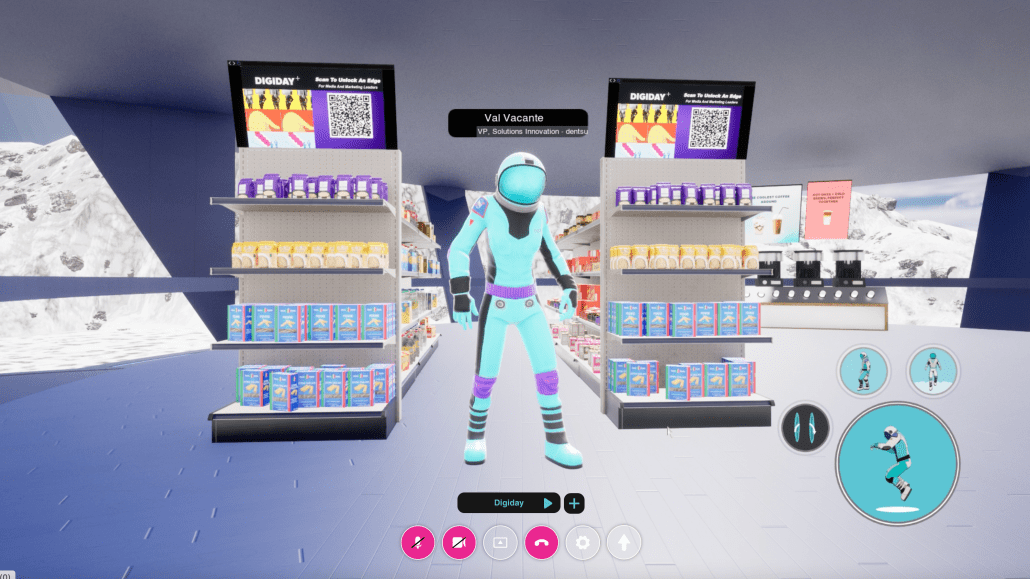
When you first land in Dentsu’s newly-built metaverse campus in a virtual reality outer space, it can feel like you’re in “Fortnite.”
While the popular battle royale game and Dentsu’s space in metaverse productivity platform HeadOffice.Space do have one thing in common — both are built on virtual world creation tool Unreal Engine 5 — users won’t be scaling buildings or blasting one another with cannons. Instead, they can test out retail concepts or build showrooms in the metaverse that will be accessible through virtually reality devices or any online mobile and desktop devices.
In the lead-up to the Consumer Electronics Show in Las Vegas in January, Dentsu and Microsoft have collaborated to launch the Dentsu NXT Space on Moon Valley, a dedicated campus on the digital moon in the HeadOffice.Space. Again, imagine Fortnite, but the avatars are in spacesuits in outer space with futuristic offices, lounges and shops.
For Dentsu, this destination is about helping guide clients into the metaverse, whether it’s hosting expert panels or testing geo-fencing and QR code capabilities. Val Vacante, vp of solutions and innovation at Dentsu, said the focus is on creating the right experience for each client. A lot of times, partners are enthusiastic but unsure about how to enter the metaverse, so the guided tour of sorts will help the agency identify ways to support clients, Vacante said.
“I’m just a firm believer that you need to be experimenting,” Vacante told Digiday. “We cannot advise clients if we are not playing, exploring, testing, winning, failing, right? So that’s what we wanted to do here.”
Earlier this month, Dentsu International partnered with publisher Decrypt Media to establish a Web3 Center of Excellence, with the aim to provide education for employees and clients on all things Web3, a vision for the decentralized internet. Others, including Publicis Groupe and Horizon Media, have similar experiments in areas of blockchain, non-fungible tokens, metaverse and gaming as Web3 interest grows.
While the full experience of the Dentsu NXT Space will launch at CES early next year, Digiday got a preview of some features coming to the space.
Microsoft-powered tools
The Dentsu Metaversity on campus will be dedicated to learning and training. One of the reasons Microsoft partnered with Dentsu is the ability to integrate its various Office and productivity tools throughout the NXT Space. Billboards and presentations are displayed around the co-working and retail spaces, all made using Powerpoint. The retail space, ShopNXT, is powered by Microsoft Dynamics 365, a suite of business and customer relationship products.
Simon Crownshaw, managing director of media and entertainment at Microsoft, said that these traditional business tools many are familiar with will bridge the gap with artificial intelligence and other cognitive and automated services that make up the metaverse.
“It’s about bringing the simplification out a little bit more, because a lot of people get confused about these developments,” he said. “It’s a fundamental evolution for developers and brands in terms of how they experience it.”
The Metaversity will also serve as a training ground for Microsoft Power Skills, where employees build skills for text-to-speech and other Microsoft Designer capabilities. Some other spaces on the Dentsu campus include the ShopNXT Showroom, Merkle Virtual Retail Lab and Intelligence Center — and the experience is guided by an artificial intelligence assistant, Neva, that also leverages Microsoft’s text-to-speech capabilities.Provided by Dentsu
Web3 education and research
Many agencies are currently focused on educating clients and partners around the application of metaverse products, considering how many consumers still struggle to understand the concept of a metaverse or decentralization.
As Eric Levin, chief content officer at Publicis Media, previously told Digiday, agencies have been overloaded with requests related to the metaverse following the rebrand of Facebook to Meta. But some of these topics and applications proved too complex for its teams and clients.
“Our first step with our clients was education,” Levin said. “We wrote multiple POVs, decks, presentations that explained what exactly was happening, what the evolution looked like, why it was happening now, what to expect and how to enter the space meaningfully and strategically.”
With the Dentsu campus, Vacante explained there are many opportunities to connect with partners in the metaverse to do onboarding for brands, staff training and other industry events. The retail spaces and showrooms can be used for research and experimentation for different products and services, whereas work rooms are designed for collaboration, recruitment and other events, such as an “Ask Me Anything” session with a Dentsu expert or a panel featuring clients.
Over in the Dentsu Intelligence Center, which from the outside is shaped like a DNA double helix, spaces will be used for showcasing research reports and creating immersive experiences to share the firm’s insights.
“We’re creating 3D, engaging environments, where you can interact with the numbers or different sorts of interactive bits to bring that thought leadership to life,” said Vacante.
Future of commerce and retail
Dentsu’s metaverse showroom and retail lab feature some of its own products that will be on display at CES, including Scan & Know technology, which allows consumers to scan virtual items to get product details and have the product delivered.Provided by Dentsu
Another retail product, UnboxIt, lets shoppers scan a QR code upon delivery and get additional content, product instructions and other subscription details. These retail products are examples of how brands can connect consumers with their current Web2 experience on mobile devices and commerce, but in a Web3 environment.
The idea of selling virtual goods is not new, particularly with gaming and recent NFT trends. Now, brands are seeking out creative agencies to explore Web3 marketing and commerce strategies. Rebecca Orlov, CEO of Web3 creative firm Epic Play Date under Brand3, works with Web3 startups and brands offering services like Web3 onboarding, digital currencies and smart contracts.
“The key is Web3 is now and the concepts [like metaverse, virtual shopping, AR and VR] are being built as we speak,” Orlov said. “This may take months or many years, but the action of moving into this timeline is happening. … It’s critical that agencies and brands learn, understand and then create.”
Many Dentsu clients, Vacante added, are particularly interested in Web3 retail integration and testing metaverse features, such as geofencing for discounts and loyalty programs, building showrooms that integrate products with their websites or even using an AI assistant like Neva in the shopping experience. And the metaverse space will allow brands to play with experiences in an affordable way.
“We encourage this as a test and learn for all brands. There are brands who just throw a ton of money into whatever is new, right? But in reality, a lot of brands don’t have that opportunity,” Vacante said.
For example, in an experiment through the Merkle Virtual Retail Lab, a partner doing diversity and inclusion research in the metaverse was able to save some 70% in costs and increase participation by 300% compared to a traditional in-person survey, according to Dentsu. There are many ways businesses can save on renting a space, recruiting, providing food and other overhead costs when not limited by real-world constraints, Vacante added.
“Pixels are endless, so you can make the space however big or however small you want,” Vacante said. “We’re making some solid progress there, and that’s just tangible math.”
 Northampton Consulting